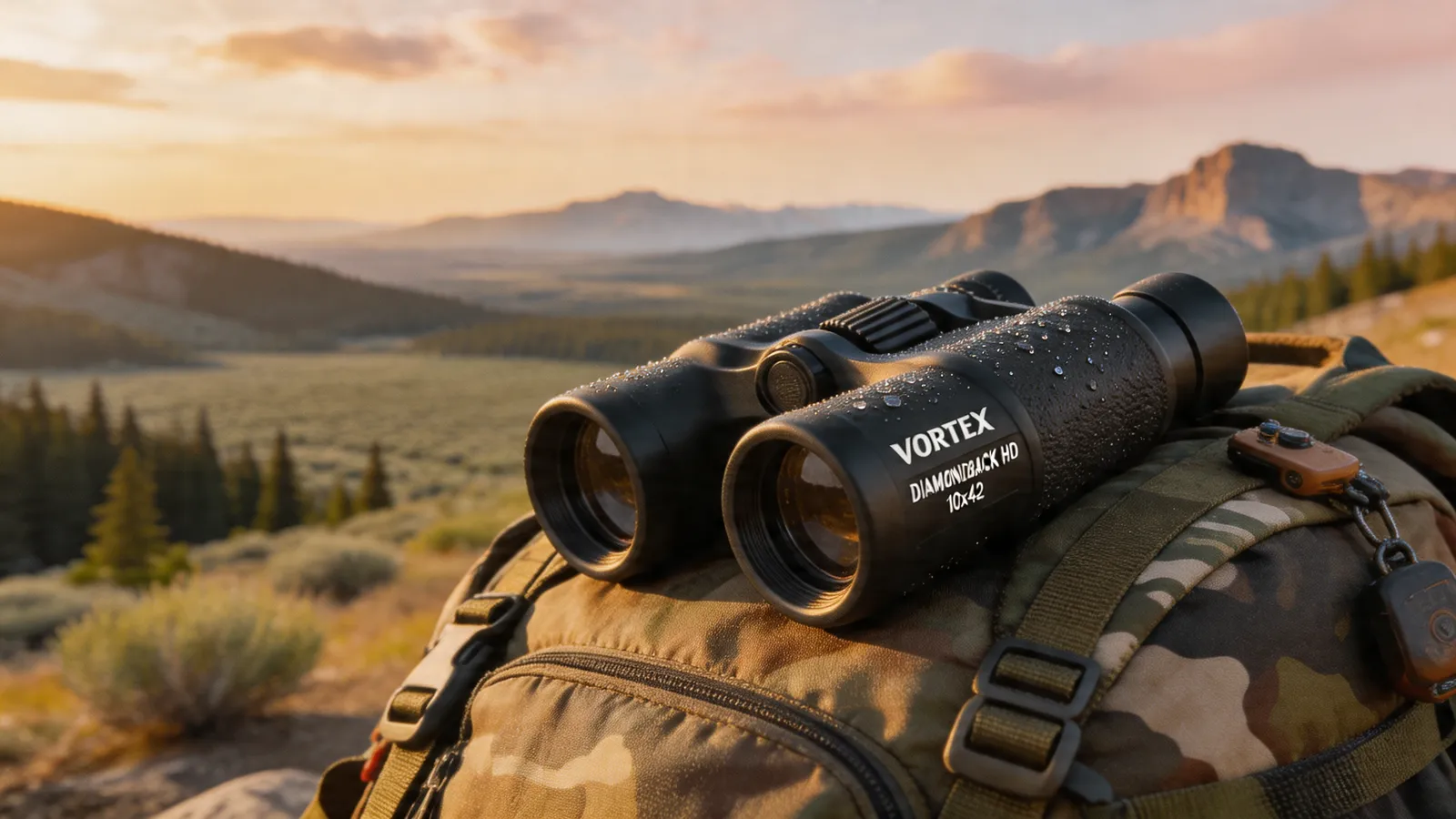
Who This Binocular Is For
If you're booking your first guided western hunt, or building out a DIY setup for elk, mule deer, or bear, you need glass that lets you sit on a ridge and pick apart distant timber for hours without your eyes giving out. Premium binos do that better. They also cost as much as a mid-range hunting rifle.
The Diamondback HD line was Vortex's deliberate answer to the question, "how good can we make a binocular at $250?" The answer turned out to be: surprisingly good. Good enough that we've watched seasoned western guides recommend them to first-time clients over more expensive options.
Glass and Image Quality
The HD designation refers to high-density extra-low dispersion glass. In plain English: the image is sharper edge-to-edge than what you'd expect at this price, and color fringing on backlit branches and antlers is genuinely controlled. Compared to the older non-HD Diamondbacks, the upgrade is obvious in the first thirty seconds of glassing.
Side by side with a $1,500 Vortex Razor UHD, the Razor pulls ahead in two specific scenarios. First, peak low-light glassing during the last twenty minutes of legal shooting light. Second, picking apart timber edges at distances over 800 yards. For 90% of what you'll actually do with binos in the field, the Diamondback HD holds its own surprisingly well.
By day four of glassing dawn-to-dusk, our eyes were tired but not destroyed. That's the real test of glass at this price point.
Field Use: Western Big Game
We ran these on three trips last fall: an OTC archery elk hunt in Colorado, a late-season mule deer hunt in Idaho, and a spring bear scout in central Idaho. Total time behind the glass: approximately 60 hours.
Glassing for Elk in Dark Timber
This is where most binoculars under $300 fall apart. Picking out the back line of a bedded bull through dense lodgepole at 600 yards is asking a lot. The Diamondback HD did it consistently in good light. In flat overcast or fading evening light, you have to work harder, and that's where you start wishing for premium glass.
Open-Country Mule Deer
Glassing sage flats and finger ridges from a vehicle or a tripod-mounted setup, the 10x42 magnification was the right call. Wide enough field of view to scan efficiently, magnification high enough to actually evaluate antler mass at distance.
Spring Bear Spot-and-Stalk
Bears on south-facing slopes during spring green-up are usually visible in good light. Glassing was easy. The Diamondback's color rendition handled the chocolate-to-cinnamon bear color spectrum without making everything look washed out.
Like the look of these binos?
Vortex backs every Diamondback with their VIP warranty, the most generous in the optics industry. No receipt, no questions, no fault required.
Check Latest PriceBuild, Ergonomics, and Durability
The chassis is rubber-armored and feels reassuringly solid in the hand. At 21.8 ounces, they're noticeably lighter than the older Diamondback line. Eye cups twist out smoothly and lock at multiple positions. The focus wheel is the right amount of stiff: not so loose that it drifts when you set the binos down, not so tight that fine-tuning at distance becomes a wrestling match.
One real-world durability test: we dropped our review pair from about four feet onto granite scree above 11,000 feet. The rubber armor took a chunk of paint loss. The optics tested fine afterward.
Pros and Cons
Pros
- Glass quality that genuinely punches above $250
- Lightweight 21.8 oz chassis is easy on the neck
- Vortex VIP warranty is unmatched in the industry
- Good color rendition across hunting light conditions
- Smooth, well-tensioned focus wheel
- Solid rubber armor and weather sealing
Cons
- Last-light performance lags behind premium glass
- Edge sharpness drops at extreme distance over 800 yds
- Included neck strap is mediocre, most users replace it
- Lens covers feel cheaper than the binoculars deserve
Alternatives Worth Considering
If you're shopping in this bracket, three other binoculars deserve a look:
- Vortex Viper HD 10x42: about $200 more, but a clear step up in low-light performance. Worth the extra spend if you can swing it.
- Maven C.1 10x42: direct-to-consumer brand, similar price, slightly better glass. Slower delivery and no in-person retail support.
- Leupold BX-2 Alpine HD 10x42: comparable price, similar feature set. Comes down to brand preference and warranty experience.
The Verdict
If you're outfitting yourself for a western hunt and don't want to spend $1,000+ on glass, the Vortex Diamondback HD 10x42 is the binocular we'd hand a buddy without hesitation. It's not the absolute best optic in the field. But for the money, it's hard to do better, and the warranty alone makes it close to risk-free.
Pair these with a quality bino harness, a tripod adapter for serious glassing sessions, and a microfiber lens cloth, and you have a setup that will outwork most hunters in the field, regardless of what's hanging around their neck.
Ready to add these to your kit?
Check current pricing and availability. Vortex regularly runs promotions on the Diamondback HD line.
Buy the Vortex Diamondback HD 10x42